

A GHOST FROM THE DEEP
Luca Valbonetti
Enicar Collector
enicar aqua-lung 1000 FT
The story of the Enicar Aqua-Lung 1000 ft: the watch that should never have existed
As rare as rare can be. Absent from European catalogues, forgotten even by experts. And yet it exists. The Enicar Aqua-Lung 1000 ft is a watch born in the shadow of a commercial arrangement, outlived history, and resurfaced — as befits a diver’s watch — after decades of silence.
I. A Call from California
It was Christmas Eve 2019. A terse message appeared in an American inbox: four lines, a spare signature. “Hello Teck, I received message from Steve Kurshner that you are reaching out to me for discussions about dive watches. You can reach me at elaroc@comcast.net. I live in California. Ed LaRochelle.”
At the other end of the chain were two men in their fifties, devoted enthusiasts of vintage dive watches: Teck Sing, a Malaysian collector based in Asia, and myself, Luca Valbonetti. We had come across Edward LaRochelle’s name while leafing through the Journal of Diving History, a niche American publication dedicated to the history of scuba diving. In the first quarter 2015 issue (Vol. 23, #82), LaRochelle was cited in connection with a watch — an Enicar Aqua-Lung 1000 ft — that almost no one appeared to have ever seen in person.
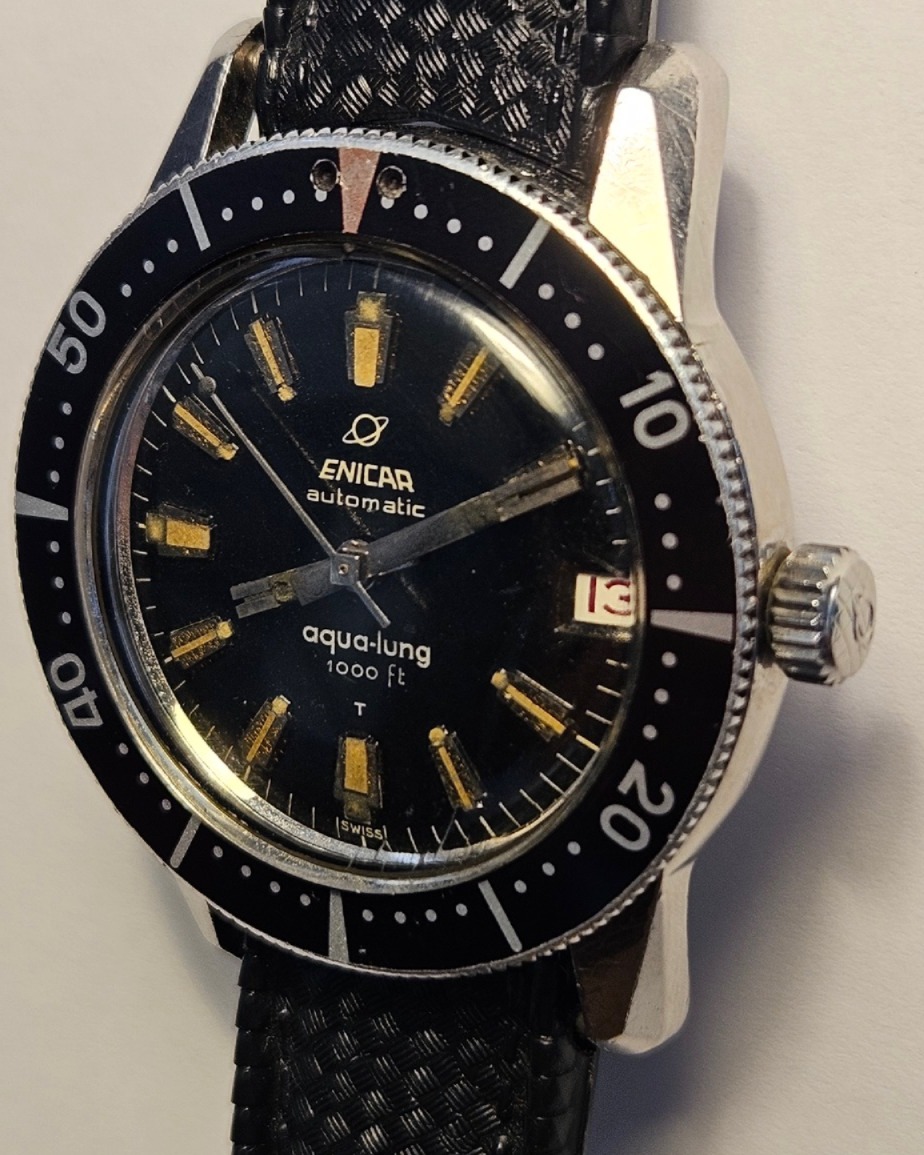
The reason for our interest was straightforward: I was wearing one of those watches on my wrist. And I had no idea what it was.


II. Enicar — A Name Read Backwards
To understand the Aqua-Lung 1000 ft, one must first understand Enicar. Few names in the history of Swiss watchmaking contain such a density of stories. The founding dates to 1 October 1913 in La Chaux-de-Fonds: Ariste Racine and his wife Emma Blatt launch a small manufacture. The family name, however, has been a registered trademark since 1870. It is Emma who has the idea: reverse the letters. Racine becomes ENICAR. The brand is registered on 6 January 1914.

In this detail — a name read right to left — lies the entire character of the brand: ingenious, unconventional, capable of doing much with little. Enicar was never a luxury maison in the classical sense. It was a Swiss precision factory, with a sporting vocation and a clientele that preferred reliability over decoration. Movements were subjected to ultrasonic cleaning — cutting-edge technology for the era, so much so that it became a marketing feature printed on the dials themselves: “Ultrasonic”. The real turning point came in 1956. A Swiss expedition climbed Lhotse and then Everest. Every mountaineer wore an Enicar Seapearl. Back home, they reported that the watches had not lost a second even at 8,000 metres. It was the perfect endorsement. The name “Sherpa” — honouring the Nepalese porters who had made the ascent possible — was registered on 6 November of the same year, and from that moment became the prefix for over one hundred different models.
“In six years of collecting and researching, I don’t think I have ever seen your version before.”
— Martin, Enicar collector, uhrforum.de, December 2019
III. America, 1966: When US Divers Came Knocking al lenggnau
In the mid-1960s, the American market for water sports was dominated by five major names: US Divers, Heathways, Dacor, Voit and Swimaster. US Divers, headquartered in Santa Ana, California, was the largest and best known: it was the official US distributor of Aqua-Lung, the commercial name for the scuba regulators co-invented by Jacques-Yves Cousteau and Émile Gagnan. The aqua-lung was the centrepiece of the Cousteau system, the object that had made the sea floor accessible to anyone who could swim.
Each year, US Divers published a catalogue: not only regulators and wetsuits, but a complete universe of accessories. Depth gauges, compasses, torches, equipment holders and watches. In the 1966 catalogue they offered two watch brands, the Blancpain 1000 feet, (listed as Date-O-Matic) and the Enicar 1000ft (listed as Enicar Super Dive). This was the first year US Divers offered an Enicar dive watch. Both watches have the same black dial, same unidirectional rotating bezel, same automatic caliber, and sold for $89.95 Guaranteed to 1,000 feet depth. US Divers cataloged the Enicar 1000ft for only 2 years, 1966 and 1967.

What’s striking when looking at the original catalogs is the name. The term “Super Dive” was used by US Divers exclusively as an internal catalog label, to distinguish the Enicar watch from the Blancpain one on the same page. It was not an official Enicar name, nor was it intended to appear on the dial. The watches that reached collectors’ hands—the few surviving examples—bear a completely different inscription on the dial: “aqua-lung / 1000 ft,” in elegant yet functional lettering. No example with the wording “Super Dive” on the dial has ever been found.

IV. The Watch on My Wrist
I had found my specimen in Italy. There was nothing outwardly extraordinary about it: a vintage dive watch, black dial with that distinctive inscription, lollipop hands, a bezel with unusually thick-font numerals. The EPSA supercompressor case — the one with its hermetic double-crown closure system that in the 1960s represented the state of the art in water resistance.
It was the case back that had raised the first questions. Engraved with care: “100/216Ba ANXS”. A code that the most expert Enicar collectors can read like an identity card — stainless steel case, reference 216, with bracelet, waterproof, date function, sweep seconds. But above all: “aqua-lung”, written on the dial. Not “Sherpa Diver 600”, not “Super Dive”. Aqua-lung. Cousteau’s name.

Opening the case back, the most unexpected discovery: the AR 1145 calibre — 24 jewels. Not 17. Twenty-four. And on the movement plate, not a single American export marking: no “OBA” (the rare customs code for Swiss movements destined for the USA), no “EZR” (the Enicar USA importer stamp), no “UNADJUSTED” (the designation that American customs law required on all movements not certified to chronometer standard). A superior-grade European movement, inside a watch listed in an American catalogue.
On the movement plate, not a single American export marking. A superior-grade European movement, inside a watch built for the American market.

V. The Collector's Network
It was Teck Sing who took the initiative: he contacted the Journal of Diving History, Steve Kushner President of the HDS (Historical Diving Society) USA. Kirshner responded by pointing him to Ed LaRochelle journalist and their Historian for vintage Scuba dive equipment. And so, at the beginning of January 2020, the correspondence began. Teck Sing and I had prepared a list of questions. Had the Aqua-Lung 1000 ft been produced exclusively for the American market? What movement did American specimens carry? What did “OBA” stand for?
LaRochelle, who has managed a collection of vintage diving equipment for decades with encyclopaedic expertise, replied with the precision of an archivist. His Enicar Aqua-Lung 1000 ft specimen — serial number 565241 — carried the AR 1145 calibre with 17 jewels, with the OBA marking and the word “unadjusted” on the movement plate. Exactly what one would expect from a watch destined for the American market. Mine, with its 24 jewels and without a single customs marking, was a different case altogether.
LaRochelle confirmed something else as well: his study of American catalogues and publications had found no trace of the Enicar Aqua-Lung 1000 ft in any European catalogue. LaSpirotechnique, the European Aqua-Lung distributor, marketed entirely different watches — the Aquastar models, also Swiss, but of a completely different lineage. The Enicar bearing the aqua-lung logo was, in all probability, an exclusively North American product.
In the meantime, I had opened a discussion on the German forum uhrforum.de, home to one of the most knowledgeable communities of Enicar collectors in the world. It was there that Martin — whose surname in the forums remains a single initial — wrote the sentence that stayed with me: “In six years of collecting and researching, I don’t think I have ever seen your version before.” Not the 17-jewel variant with the OBA marking. Mine. The European 24-jewel.
VI. The Movement Question: A Swiss Enigma
The question that remains open is seductive in its simplicity: how did an Enicar AR 1145 movement with 24 jewels — of European production — end up inside a watch destined for US Divers’ American catalogues?
The hypotheses are several, and none can be ruled out. The first is the “mixed batch” theory: Enicar, like many Swiss manufacturers of the era, assembled watches drawing from movement stocks that could come from different production runs. It is not impossible that some units destined for American export were assembled with movements from the European line, for reasons of stock availability or simple production continuity. In that case, the movement would not have received customs markings because it had not been formally declared as such.
The second hypothesis is more intriguing: that my specimen was never destined for the American market at all. That it was, instead, one of a very small number of units produced for the European market — perhaps for testing, perhaps as a presentation sample, perhaps as an alternative version that never found an official distributor. In that case, the absence of customs markings would simply be correct: they were not needed.
Martin, in the same forum discussion, raised a third point: the AR 1145 dates from the early 1960s (around 1963), while the EPSA Seapearl 100/216 case was already in production by 1962.
It is possible that cases and dials were held in warehouse stock for a year or two, then assembled with movements from a slightly later generation. This would also explain the discrepancies between the various known specimens — bezels with different fonts, dials reading “1000 ft” versus “1000 feet” — as the natural result of serial assembly drawing on heterogeneous stock.

VII. The Diver 600: The Father of It All
To understand the Aqua-Lung 1000 ft, one must trace it back to its direct ancestor: the Sherpa Diver 600, introduced by Enicar in 1958. In 1958 the US Navy subjected three dive watches to rigorous comparative testing. The competitors were illustrious: the Blancpain 50 Fathoms, already celebrated as the preferred watch of the French Marine Nationale, and the Rolex Submariner, which was conquering wrists across the English-speaking world. The third challenger was Enicar’s Diver 600. According to research by historians and collectors, it was the Diver 600 that emerged as the US Navy’s preferred choice. A silent victory, little publicised, but documented.
In the same year the Navy was putting it to the test, a Diver 600 found its way onto the wrist of Captain Bo Cassel (1920–2004), a Swedish naval officer who in 1961 led the salvage operation for the warship Vasa, which had sunk in Stockholm harbour in 1628 after just twenty minutes at sea. When the Vasa broke the surface after 333 years on the seabed, the watch on Cassel’s wrist was that Diver 600. Total production for the US Navy is estimated at approximately one thousand units — a small number, which explains why these watches are so difficult to find today
The Aqua-Lung 1000 ft is, technically, a Diver 600 with a different dial. But that different dial tells a different story: no longer a military or professional working tool, but a premium consumer product aimed at American enthusiasts of the nascent recreational diving sport.

VIII. Ghosts from the Deep — The Unresolved Mysteries
Every great collector’s watch carries its own mysteries, and the Enicar Aqua-Lung 1000 ft is no exception. If anything, it seems purpose-built to frustrate documentation purists.
The First mystery is, who suggested adding “Aqua Lung” to the Enicar dive watch dial. Was it the suggestion of Enicar or US Divers? Ed LaRochelle believes it was US Divers who (requested) it. Ed continues, US Divers was very keen on labeling their products with the trade name “Aqua Lung”. The Second mystery is one of numbers. How many specimens were produced in total? No one knows. No surviving factory records have been found. From the serials of the known examples (565241 and 569844) one might infer production in that numerical range, but it is impossible to determine how many units that range comprises. It could be dozens. It could be hundreds. It could be fewer.
The Third mystery is the European one. If the Aqua-Lung 1000 ft was an exclusively American product, how did my specimen — with a European movement and no US customs markings — come to be found in Italy? Was it destined for a European distributor that was never activated? Was it a sample left in a warehouse in Lengnau, completed a few years later?
“Hmmm… it stays a bit of a mystery.”
— Martin, after examining photographs of the specimen
IX. Collecting the Mystery
There is a sentence that Edward LaRochelle wrote in his email of March 2020, almost in passing, as a marginal note: “Not much information or advertisements found for the Enicar Aqua-Lung 1000. US Divers catalogs have the Enicar Aqua-Lung model but only those 2 years.” Only two years. Only two catalogues. And then silence.
In 1968, the Aqua-Lung 1000 ft vanished from US Divers’ catalogues without explanation. No press release, no official communication, no clearance sale of a “last model”. It was simply no longer listed. As though it had never existed
This, perhaps, is the characteristic that makes this watch so compelling for the collector. It is not a luxury product with a glamorous story, not the watch of a Formula 1 driver or an astronaut. It is something more subtle: an object born at the intersection of a Swiss precision company and the greatest sporting revolution of postwar America — the mass democratisation of scuba diving, made possible by Cousteau, fuelled by television programmes like Sea Hunt with Lloyd Bridges, promoted by retailers like US Divers. A watch that bears witness to a precise moment, now forgotten, when the exploration of the deep seemed the most exhilarating frontier one could possibly cross
Martin, the German collector with whom I exchanged messages for weeks, wrote something that struck me: “It’s much more exciting than collecting the ‘big brands’.” He is right. Collecting a 1966 Rolex Submariner is collecting the history of a certified industrial success. Collecting an Enicar Aqua-Lung 1000 ft is collecting a fragment of minor history — and for that very reason, in some measure, a more authentic one.
X. A Final Note: The 24-Jewel Enigma
I close with what remains the question that fascinates me most. My specimen carries the AR 1145 calibre in the 24-jewel version — the superior-grade variant, normally reserved for the European market, where American customs rules did not impose a downgrade to 17 rubies to avoid the import surcharge on high-end watches.
It bears none of the markings it would have needed had it been officially exported to the USA.
And yet it is, unmistakably, an Aqua-Lung 1000 ft: the dial says so, the case says so, every single constructional detail says so. It is a watch that seems as though it should not exist: too European to be American, too American to be European.
Perhaps this is precisely the appeal of the rarest vintage watches. They are never merely objects: they are unanswered questions, remnants of decisions made in boardrooms that no longer exist, by people whose names appear in no archive. The Aqua-Lung 1000 ft is a watch that knows its job — measuring time underwater — and in the meantime carries with it, in its engraved case back, a story that still waits to be written in full.
Notes and Sources
Quotations from Edward LaRochelle, Martin and Teck Sing are drawn from direct correspondence (December 2019 – March 2020). Information on the 1966 and 1967 US Divers catalogues has been verified against original scanned copies shared by LaRochelle. Technical data on calibre AR 1145 are taken from OldSwissWatches.com and enicar.org (Facts, Figures and Features, updated 2024). Historical information on Enicar is confirmed by Chronopedia.club/Enicar and Vintage Watch Inc. (vintagewatchinc.com). The Diver 600 advertisement in Skin Diver Magazine is dated June 1959. The Journal of Diving History, Vol. 23 #82, first quarter 2015, is the original source that led to the identification of Edward LaRochelle.
SOURCE | DESCRIPTION | LINK |
Enicar.org | Facts, Figures and Features — cronologia completa del marchio | |
The Springbar | Enicar Sherpa Collector’s Guide Pt. 1 — guida ai modelli | |
Uhrforum.de | Sammelthread Enicar Uhren — forum collezionisti (DE) | |
Vintage Enicar | Schede modelli Enicar — storia e varianti | |
Vintage Watch Inc. | Storia del marchio Enicar | |
Chronopedia | Storia, numeri di serie e cronologia Enicar | |
OldSwissWatches | Specifiche calibro AR 1145 | |
Watch-Deal | Guida ai modelli Sherpa Enicar | |
WatchesGuild | Buying Guide — autenticità e calibri Enicar | |
Journal of Diving History | Vol. 23, #82, Q1 2015 — fonte originale su LaRochelle |
Luca Valbonetti | Marzo 2026

THE HISTORY OF MARTEL WATCH
Text by Nicola1960Collector, Researcher, Author Article published on the Orologi&Passioni Forum