

THE HISTORY OF MARTEL WATCH
Text by Nicola1960
Collector, Researcher, Author
Article published on the Orologi&Passioni Forum on June 19 2024
“Martel Watch”: from the beginning to production in the 1950s
INTRODUCTION
In the Italian forum “Orologi e Passioni,” there has been much discussion of the “Martel Watch” company in Ponts-de-Martel, a village near the town of Le Locle, and in particular its relationships with “Universal Genève” and “Zenith” (1, 2, 3, 4, 5, 6).
In other specialized international forums, I have also personally participated in the reconstruction of these relationships between the three Swiss companies (7) and have learned of Marco Strazzi’s important research (8), which has been decisive and conclusive. My personal thanks go to all the friends and authors who have contributed to this topic.
These discussions and comparisons, supported by original and unpublished documents, date back many years but have become increasingly clear over the years, to the point of outlining a coherent history free of historical short circuits.
The “Martel Watch.” COMPANY
In 1911, Georges Pellaton (1865–1950), a 46-year-old former technical director at Le Phare, after sixteen years at the Le Locle factory, where he designed refined repeating movements, including for the Tsarist Russian market, felt ready to take the big step of opening his own company.


Georges Pellaton belonged to an illustrious family of watchmakers; his father, Albert Pellaton-Favre, in fact, was already manufacturing “tourbillons”, and it was he who introduced his sons to this branch of watchmaking in Le Locle. He himself was the son of a large family: 4 sisters and 8 brothers; and all were qualified watchmakers, even renowned ones; one of them, Mr. Jämes-Cesar Pellaton, was the esteemed director of the Technicum in Le Locle.
The financial means were modest but the enthusiasm convinced some of the family members and acquaintances to lend what was needed for the purchase of tools and to rent a room at number 5 Rue du Chemin-Blanc, in Le Locle, where the newly founded Georges Pellaton-Steudler company established its headquarters, focusing on the production of repeater watches and chronograph movements. Demand for the latter category of watches was rapidly growing, especially in Le Locle, and Pellaton soon became a favored manufacturer. Georges Pellaton-Rickli junior immediately joined the company at the time (9).


Forced by shaky finances to seek partners, Pellaton found one in Edmond Mathey-Tissot, a solid industrialist from Les Ponts de Martel and owner of the company of the same name, assisted by Albert Guye, Mathey-Tissot’s partner, and Bernard Perret-Roulet, an accountant. The agreement between the four, signed on June 24, 1914, was the prelude to the transfer of the business and the change of name to “Martel Watch,” after the name of the town. Edmond Mathey-Tissot, however, did not appear on the board of directors.
In 1914, the company moved into the new premises, concentrating all production there, and made a decision that would shape its future.

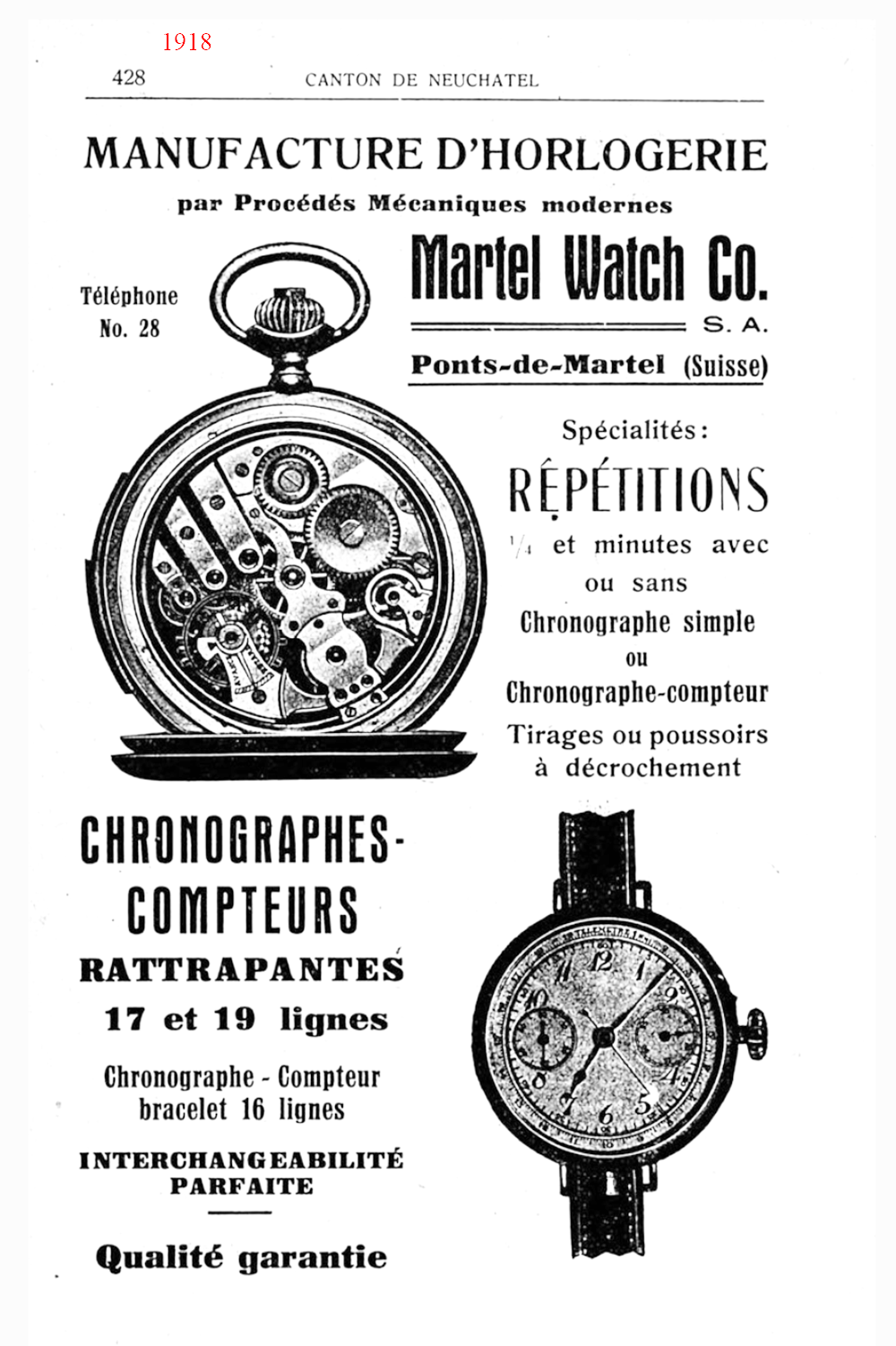
To compensate for the decline in orders caused by the Great War and the disinterest in repeating movements, due to the increasingly widespread use of luminescent dials and hands, which reduced the demand for repeating watches in the dark, Pellaton designed a high-quality chronograph movement that earned the appreciation of military suppliers, including Universal Watch, then in Le Locle, which the company boasted was the world’s first wrist chronograph. Its first wrist chronographs of 1917 were equipped with this 17-ligne movement. These were monopusher movements with the chronograph pusher integrated into the crown, as in pocket chronographs, or at 2 or 6 o’clock. Raoul Pellaton then joined the company.
Bernard Perret-Roulet left the company in June 1919, exactly five years after its founding, and was replaced by René-Philippe Pellaton, George’s son. Trained as an accountant, René continued to work with the company until its acquisition by Zénith in 1959.

The post-war period brought new pitfalls. The economic crisis of 1920-22 was so serious – a 45% drop in Swiss watch exports – that the Confederation launched the first state intervention in history to support the sector (10).
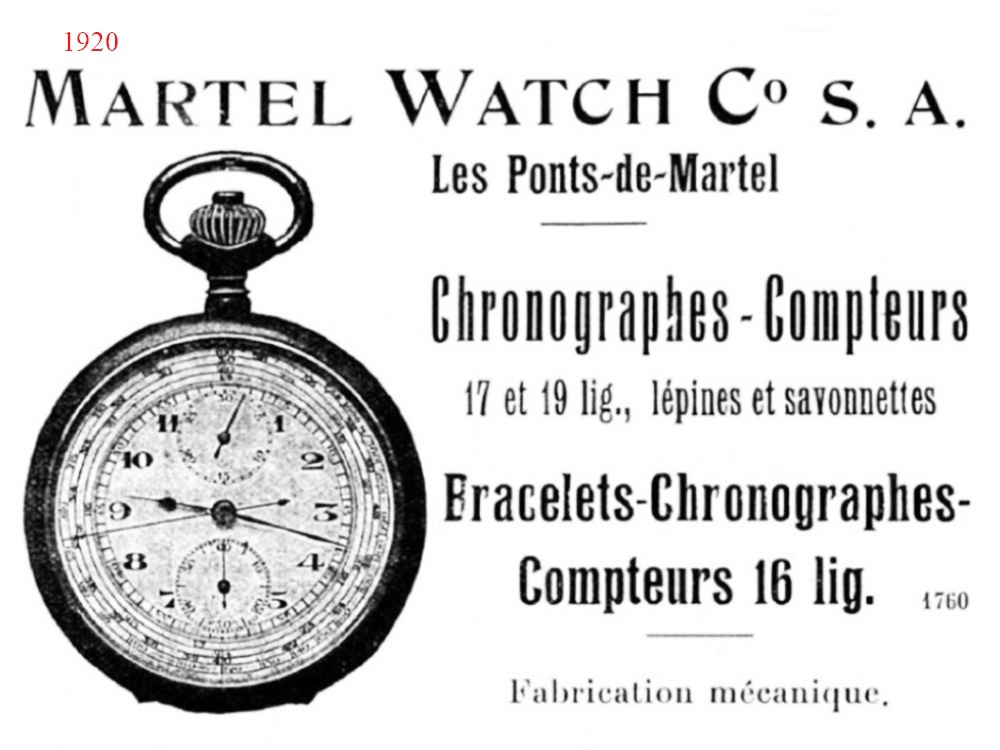


Lacking orders, Pellaton created a 17-ligne flat movement for pocket watches in order to diversify production. In 1923, one of the creditor banks demanded repayment of a loan, and “Martel Watch” was on the brink of bankruptcy. A tragic event and the new caliber saved the company. The earthquake that struck Japan in 1923 (11) destroyed the warehouses of local watchmakers, who had to turn to Switzerland to meet their commitments to customers. Martel received such a large order that the bank regained confidence and waived the repayment.
The watch also enjoyed good commercial success on the American market.
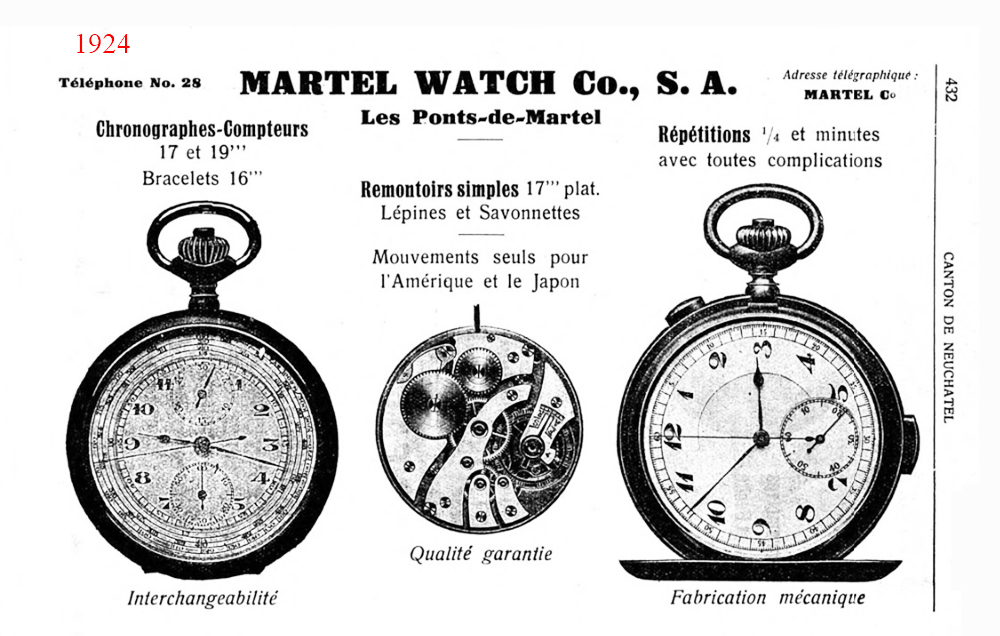

For the first time, the company could entertain growth ambitions. In 1927, a chronograph movement was created, produced exclusively for Universal starting in 1929, and in 1929, the two sons, Georges Pellaton Junior and Raul Pellaton, joined the board of directors.


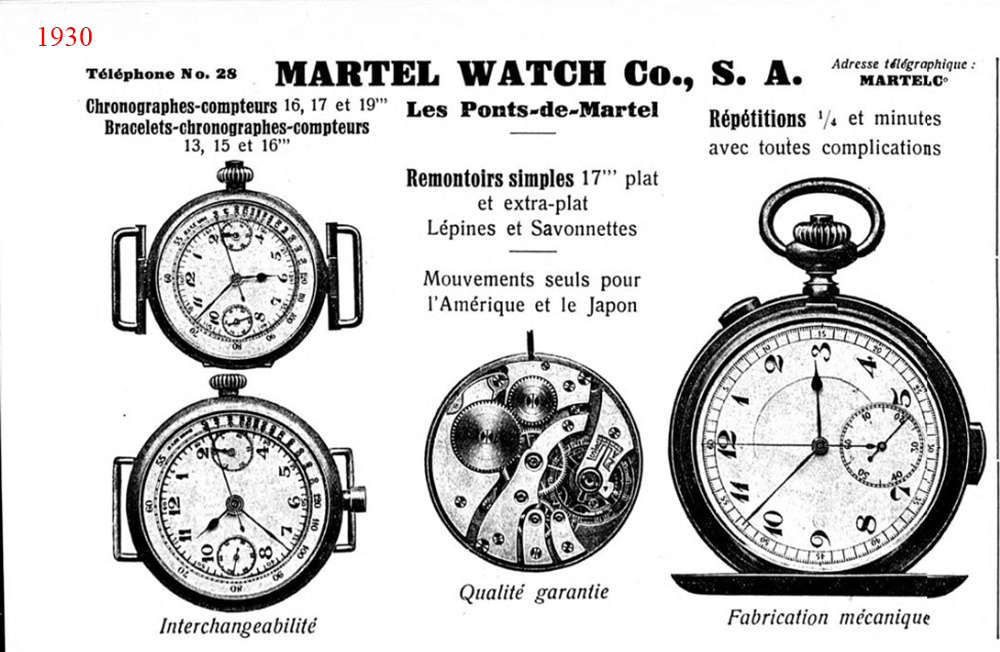
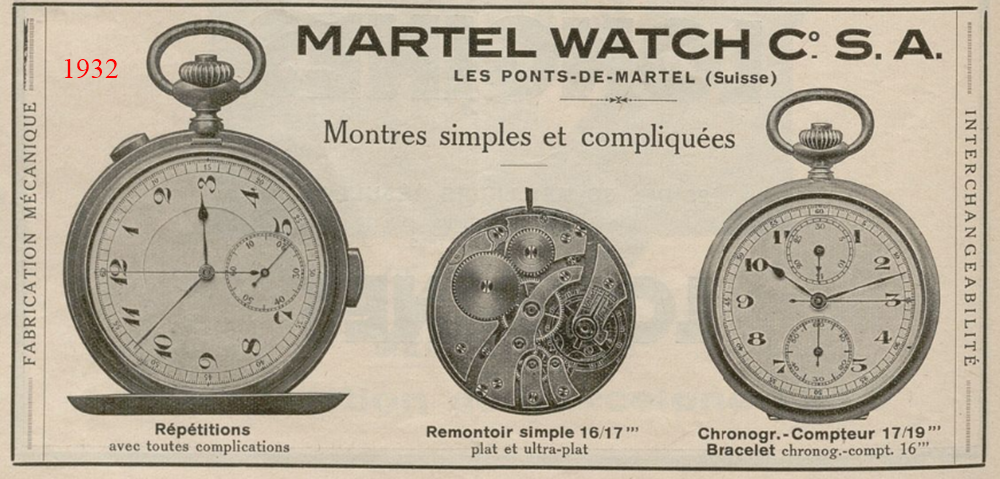
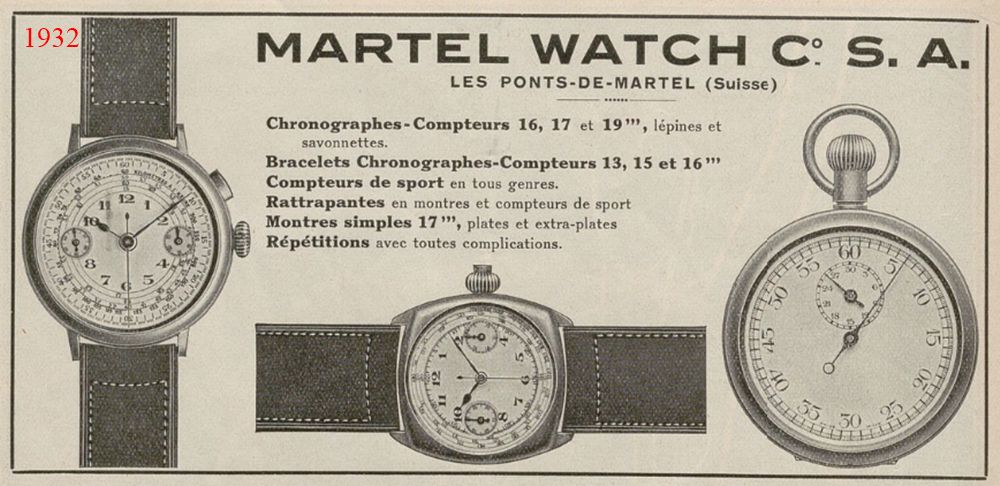


The increasingly profitable relationship between the two companies and the massive sales in the United States encouraged Pellaton to invest by buying the partners’ shares and becoming sole owner in 1933.

Martel survived the Great Depression almost unscathed and in 1934 presented a novelty that established Universal among the leaders of chronograph technology. Its Compur, with double column wheel, is the second two-button chronograph in history after the Breitling, created a year earlier. Its design with two subdials, small seconds and minute counter, and buttons at 2:00 and 4:00, becomes the model for all future chronograph watches.

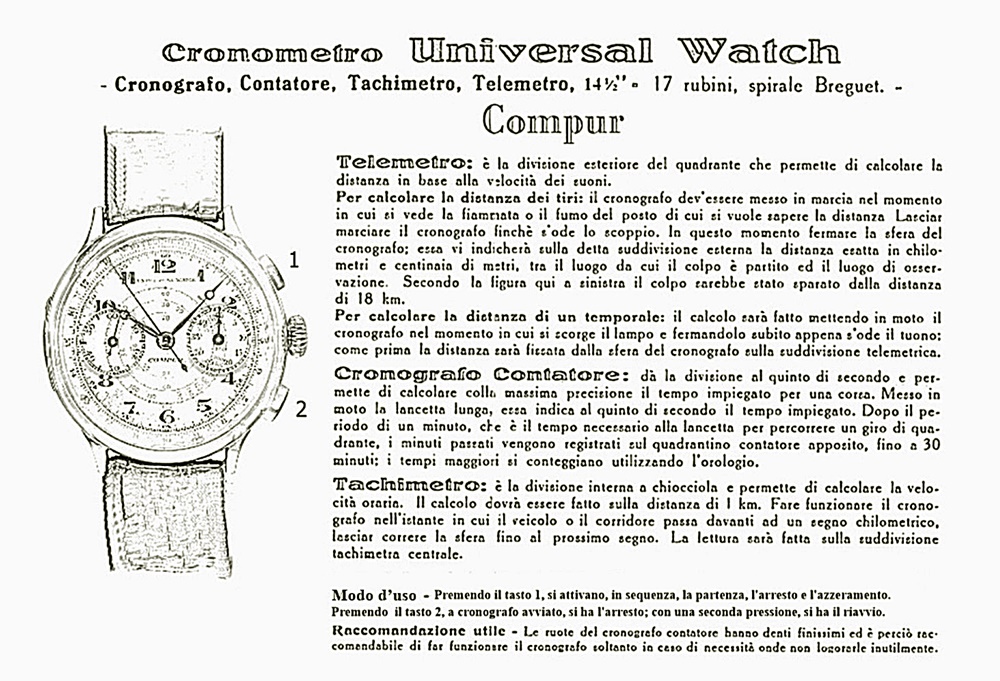

A year or two later, in 1935 or 1936, Universal launched a three-counter chronograph, with an hour counter, first called “Contax” and later “Compax”, the first in the world.

The time was ripe for a marriage between Universal and Martel similar to the one celebrated by Rolex and Aegler in 1920.
In 1936, the Geneva-based company acquired a significant stake in the company (8), which in turn guaranteed its production exclusively (or almost exclusively) to what was no longer just a client. The partnership flourished and required the expansion of the factory in 1940. The inauguration was a historic event for the small town where 80 of the 1,500 inhabitants worked at “la Martel,” as the employees called it.
Martel chronograph movements were available in sizes from 12 to 15.75 lignes and with two or three counters, but they were all substantially similar. This was the hallmark of Georges Pellaton (then called Pellaton-Dubois, after his second marriage), who focused on simplifying complicated watch movements and using as many identical components as possible. These movements were called Cal. 281, 282, 283, 284, 285, 287, 288 and 292 by Universal or 122, 136, 146, 156 and 166 by Zénith.
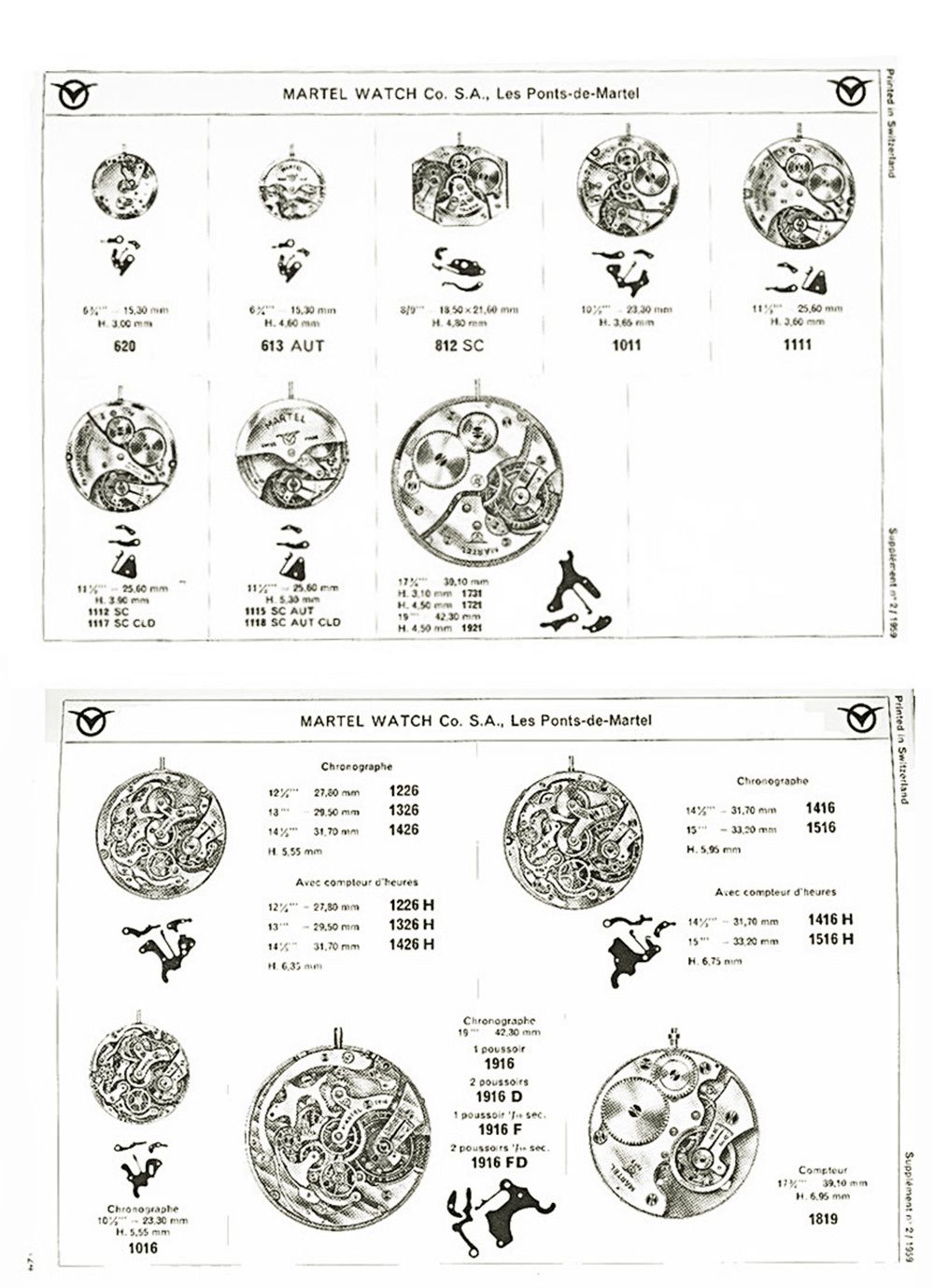
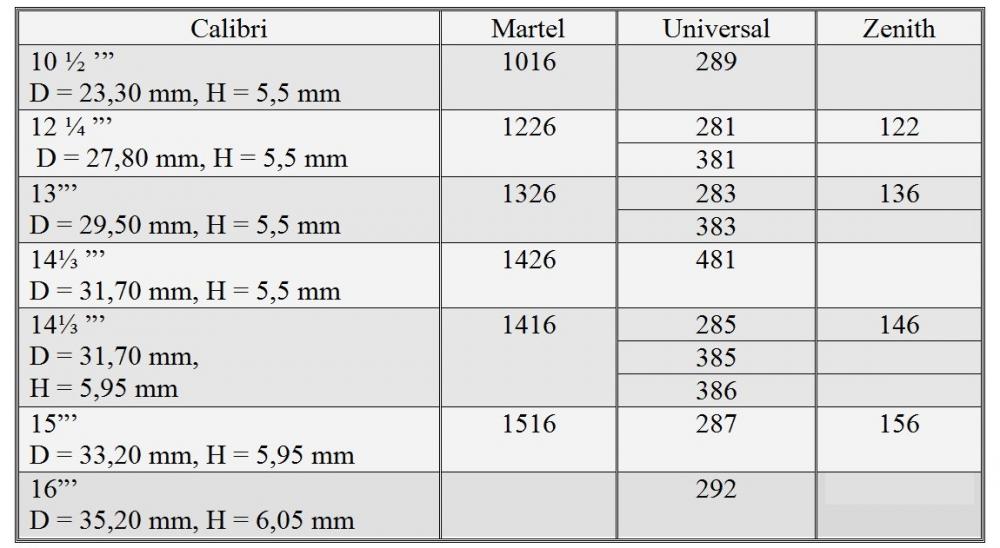
In 1937, the Martel factory was expanded with the purchase of the underlying garage, which was replaced by new workshops.
In 1941, Universal Genève provided funding for a complete renovation of the building, adding two floors and an attic. The building’s façade then bore the name “Universal,” and the company declared that the chronograph movements produced there were manufactured in-house. This was facilitated by the fact that Universal Genève’s president, Raoul Perret, also served on the boards of directors of Martel and Zénith.
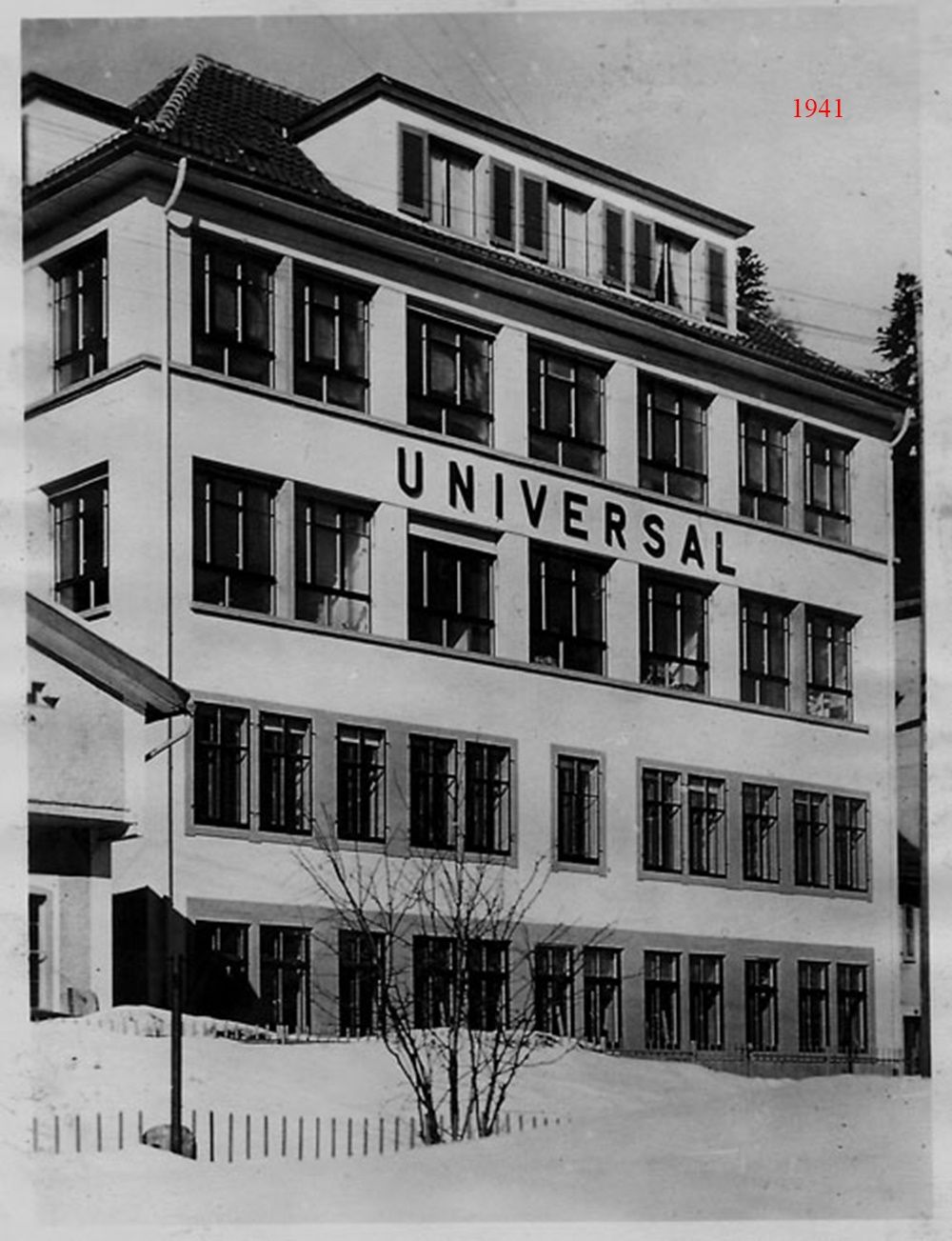
Renovated and expanded in 1941, the manifacture took the name of its main partner.


At the time, however, the “Martel Watch Co.” was still owned by the Pellaton family, and in 1944 it celebrated the 30th anniversary of its move to Ponts-de-Martel.
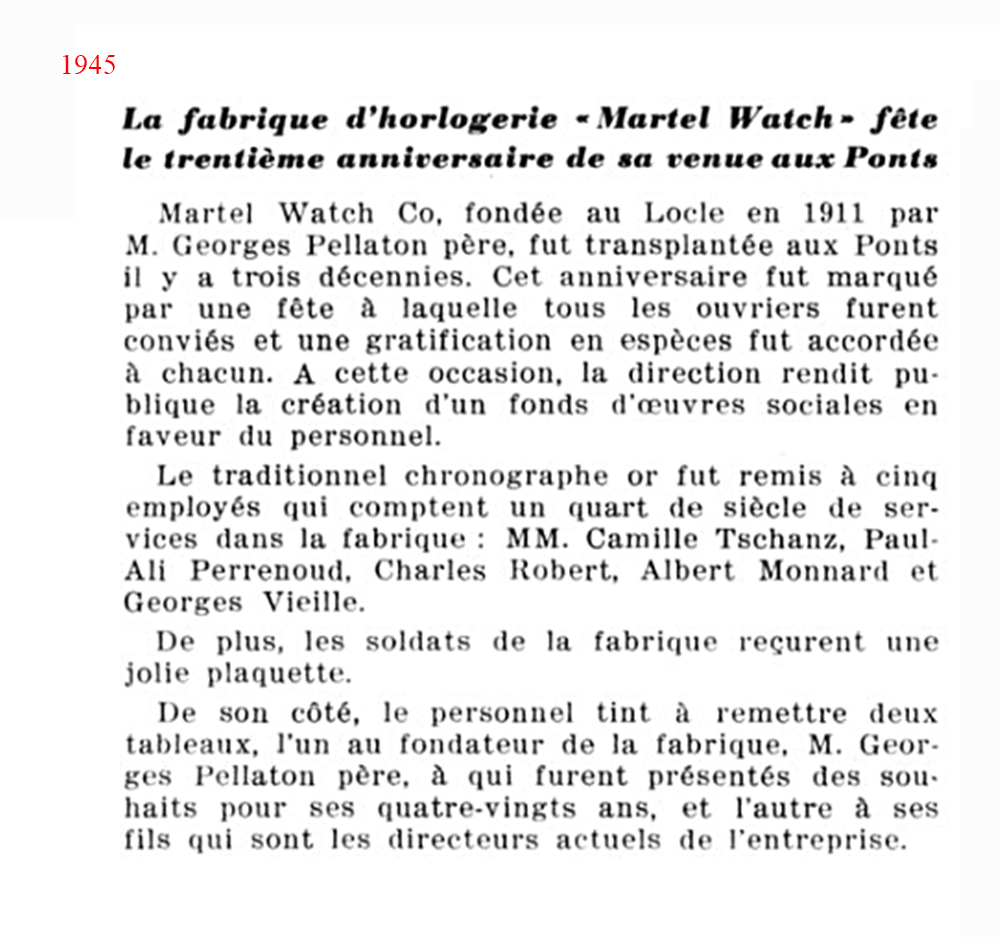
During World War II, the Martel company manufactured tens of thousands of onboard instruments that Universal sold to the air force. At the same time, it diversified its business by creating additional complications for chronographs (the Aero-Compax was produced in 1942 and the Tri-Compax in 1944), calendar movements, and a time-only movement with a direct-seconds central hand.
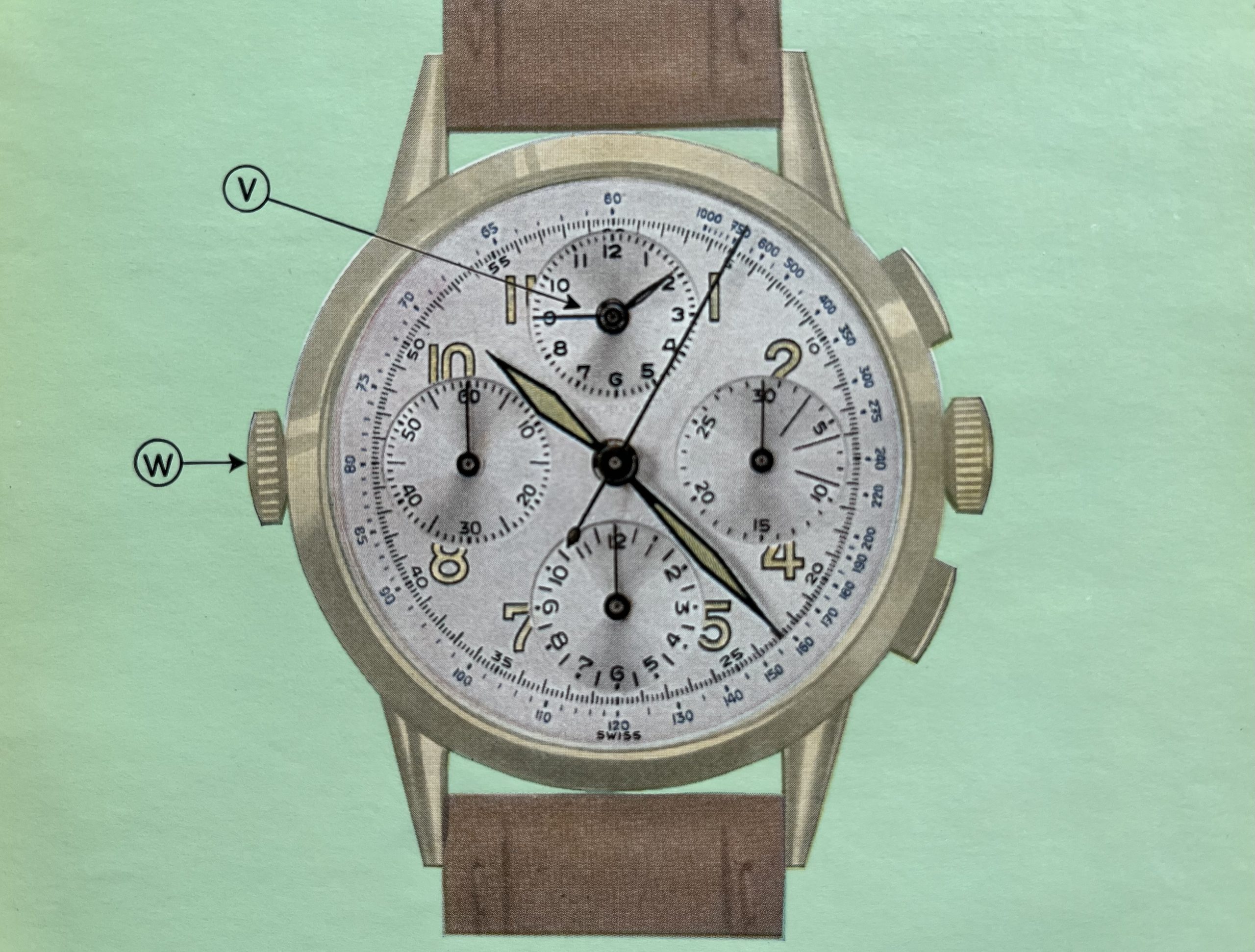
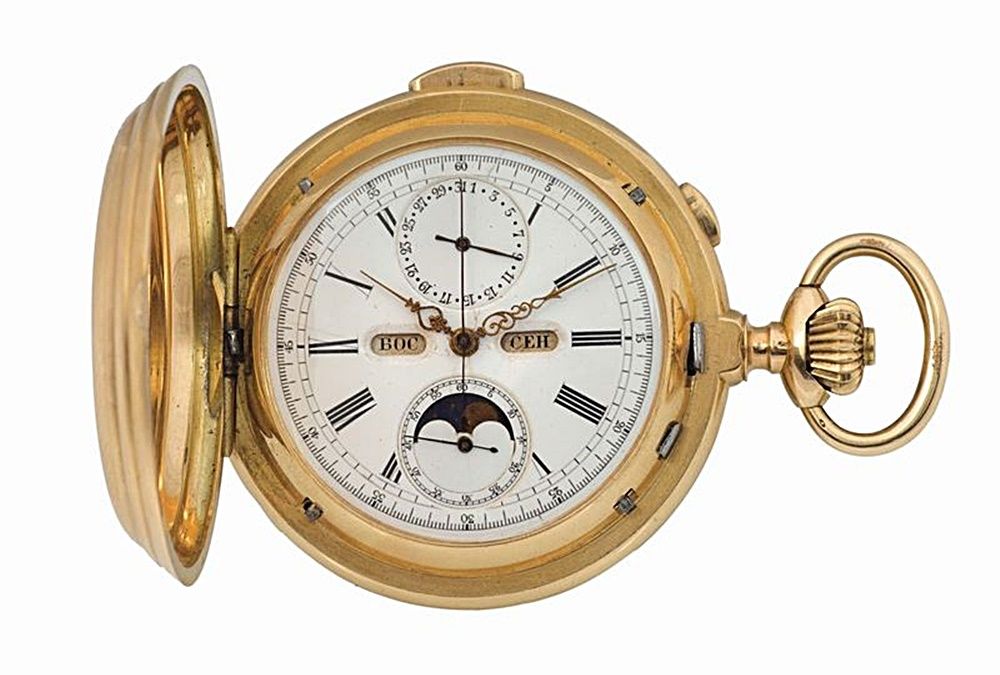
The next major success for Martel Watch, with partners Universal and Zenith, was the introduction of a wrist chronograph with a calendar complication. Launched around 1942, the new four-counter design added a subdial at 12 o’clock to display the date, and two years later, two adjacent windows were added for the day and month and a moon phase indicator.
Georges Pellaton retired in 1942 when Universal Genève acquired a majority stake in the company, retaining the honorary position of Vice President. The company was taken over by his three sons, Georges, René, and Raoul.
***
Let’s pause the narrative for a moment to reflect: it is possible to demonstrate that both the 1934 “Contax” chronograph and the 1942 “Aero-compax” chronograph were designed and produced by “Martel Watch” and then marketed by “Universal Genève.”
The Universal “Contax” chronograph is characterized by the presence of an additional wheel, located on the dial side, which allows, after starting the chronograph and pulling out the winding crown, the chronograph hour hand in the subdial at 6 o’clock to be adjusted. According to the author of the recent monograph (12), this additional function would allow the chronograph hours to be set to:
a) display a second time zone;
b) perform a sort of countdown.
c) serve as a reminder…
As I’ve already indicated elsewhere, I’ll try to clarify why, in my opinion, the Universal “Contax” chronograph exhibits this curious behavior, urging the watchmakers to intervene if they find any errors in my… “reasoning.”
In almost all chronographs with hour counters (improperly called “three-counter” chronographs; in reality, they have three subdials: the running seconds dial, the minute counter dial, and the hour counter dial, and therefore have two counters, not three…), the hour counter wheel (B), located on the dial side, is driven by the barrel wheel via a pinion P and a double idler wheel (C and C’).
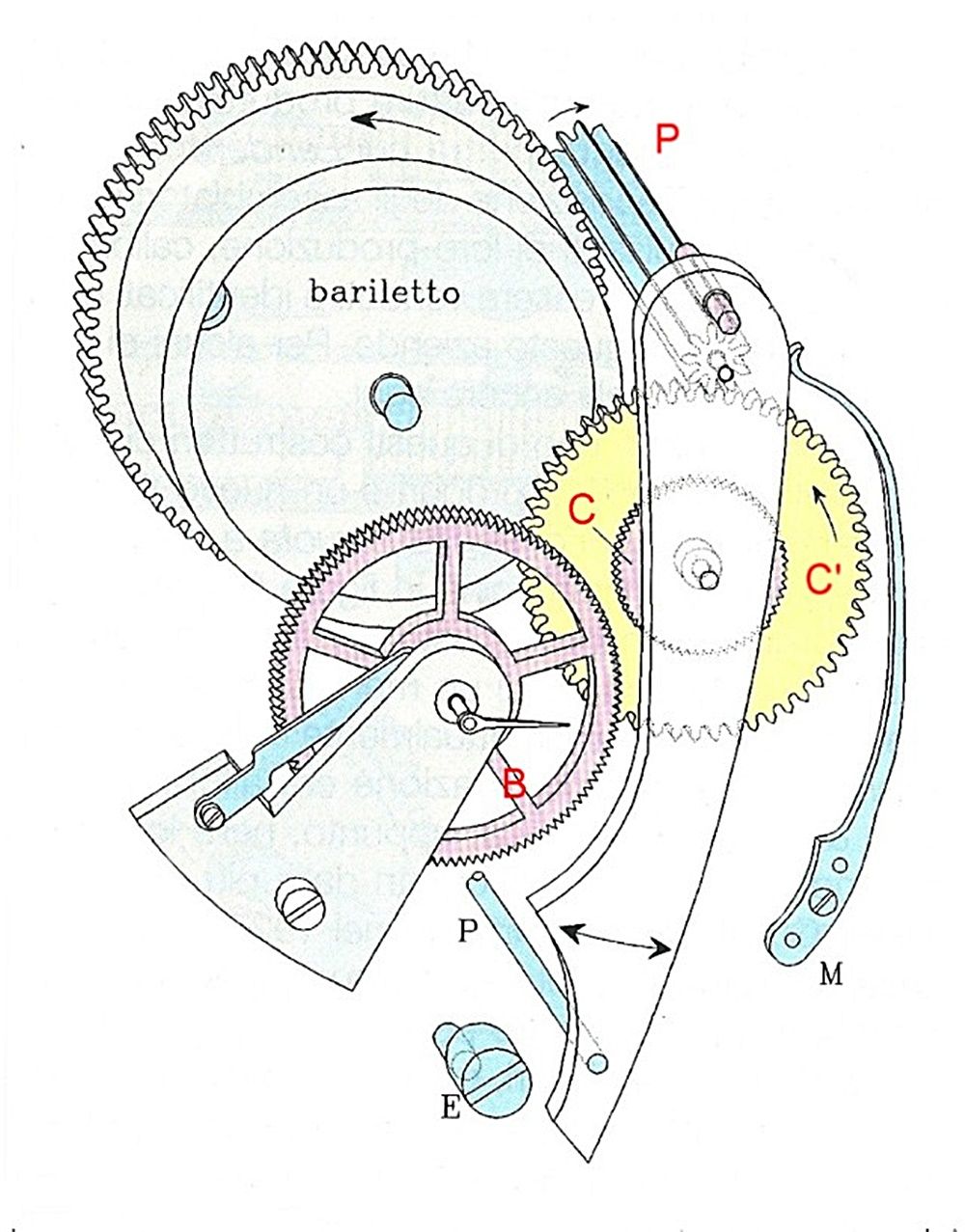
The same mechanism was also used in the Universal “Compax” chronographs (12).
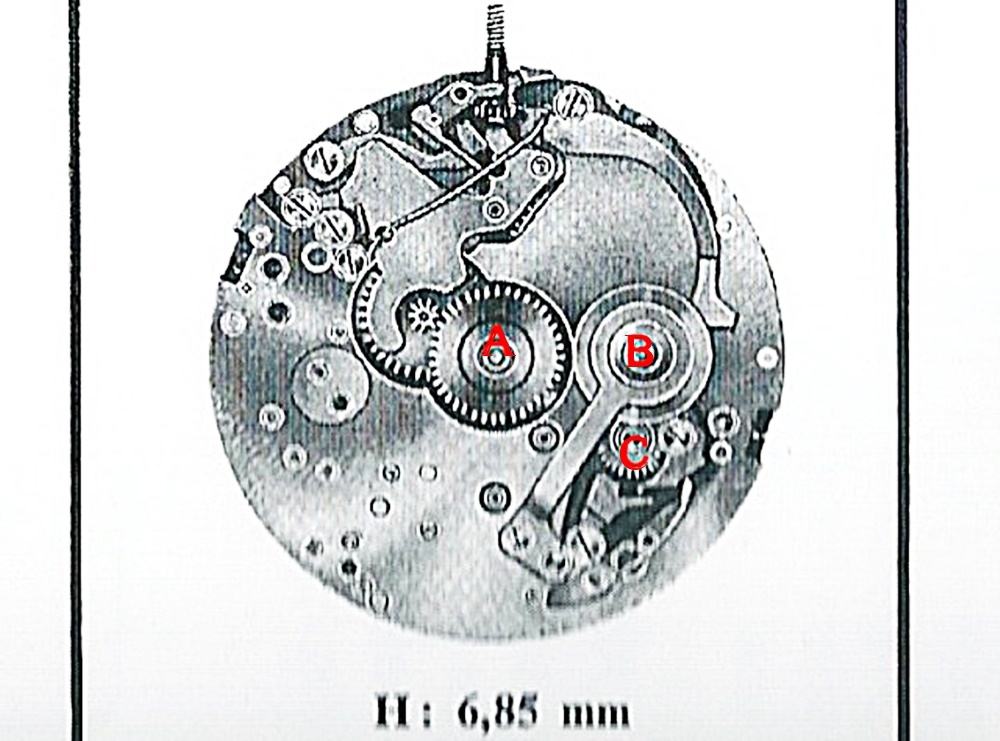
In these drawings of the Universal calibers, it is possible to glimpse the double clutch or transmission wheel (C and C’).
It should be noted that the hour counter wheel (B) is not driven at all by either the central chronograph seconds wheel or the chronograph minutes wheel, which would have insufficient energy to move the chronograph hour hand.
Nor is it driven by the cannon or hour wheel (A), as we will see in the Universal “Contax” chronographs.
In the Universal “Contax” chronographs, however, the hour counter wheel (B) is driven by the double cannon wheel, the one that indicates the hours in a watch (A and A’ [the second wheel is shown dotted in the patent drawing]) via the clutch or transmission wheel (D).
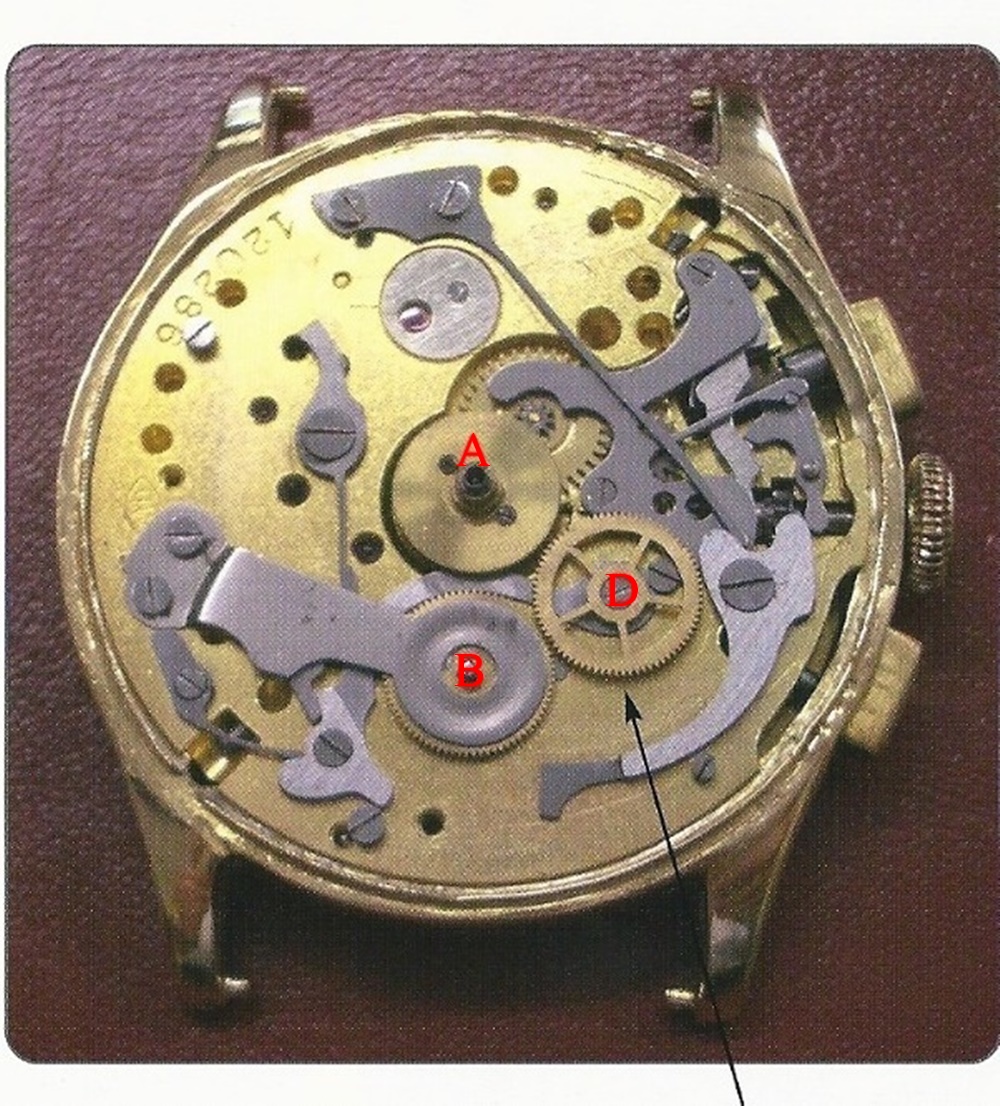
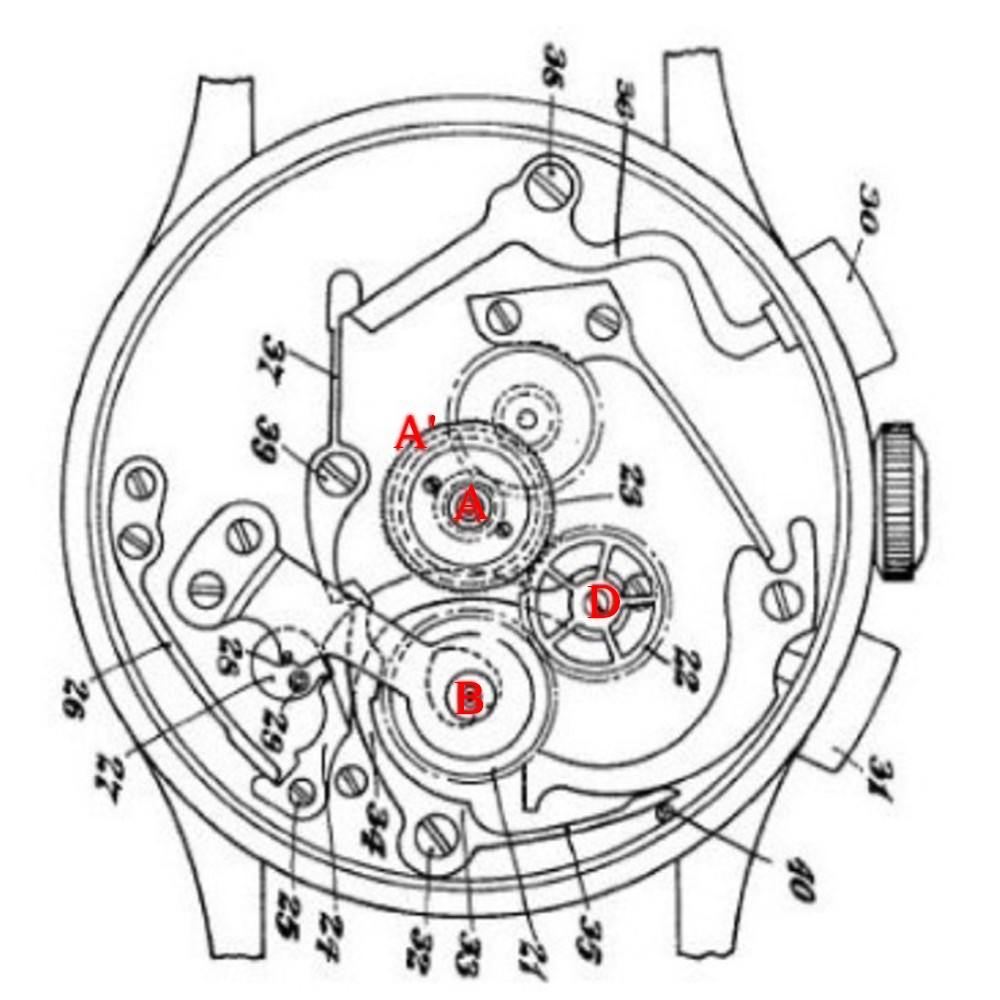
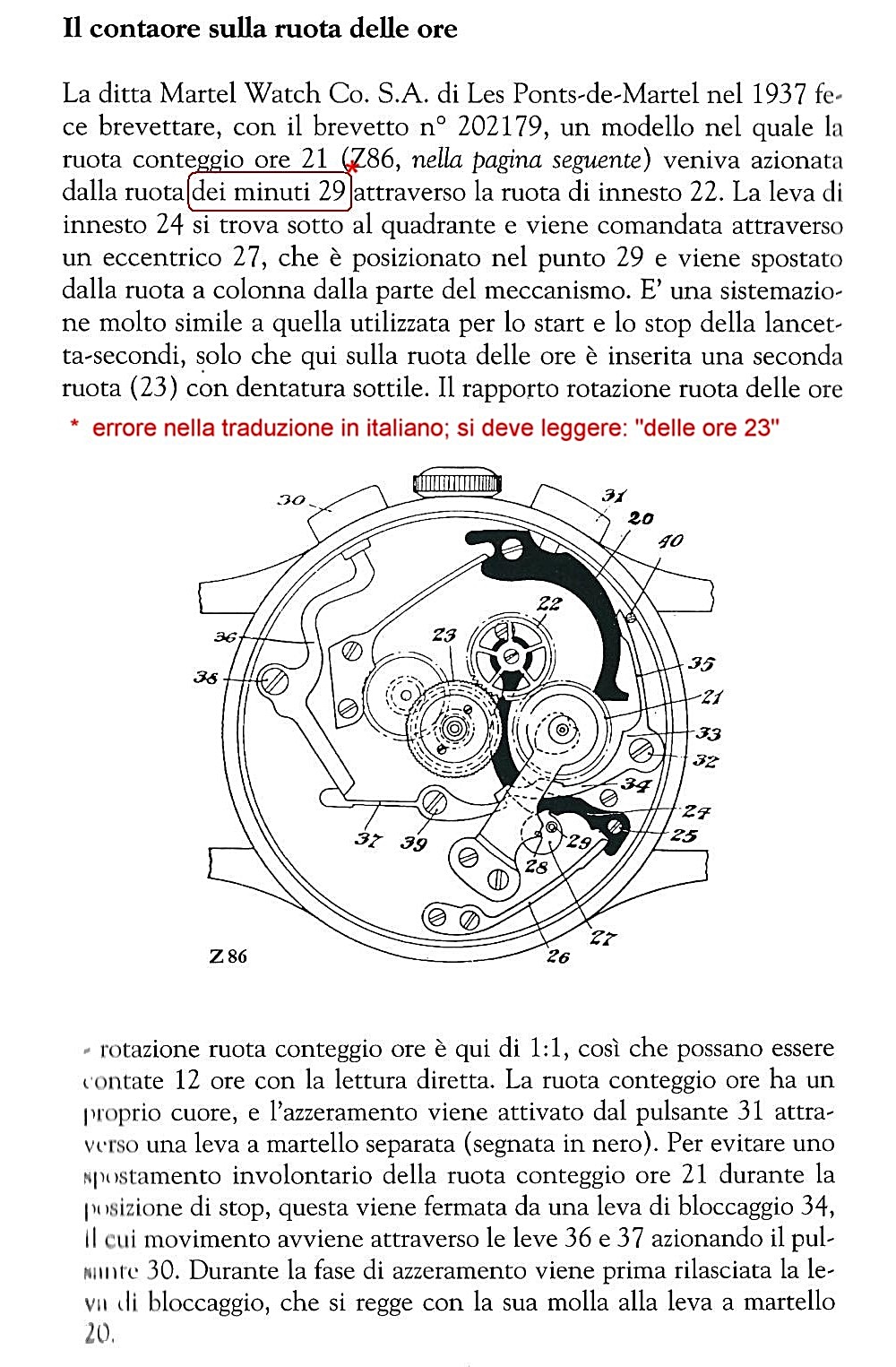
The classic book “Wrist Chronographs” by Gerd-R. Lang and Reinhard Meis details three different hour counter patents, registered over the years; the first of the three patents, the oldest, which likely served as the basis for the “…first wrist chronograph with hour counter…” is the one illustrated above.
It is therefore clear that this “Contax” chronograph features a third wheel, namely a clutch or transmission wheel (D), located on the dial side and not found in any other chronographs I know of.
This also explains the curious functioning of the hour counter of the “Contax” chronograph, described by Pietro Giuliano Sala in his book (12) on page 286:
“….the chronograph photographed on the right has the characteristic of being able to move the chronograph hour hand at will, simply by operating the chronograph and simultaneously extracting the winding crown; after having carried out this operation, by rotating the winding crown, one can notice that not only the hour and minute hands move, but also the chronograph hour hand.”
In fact, when operating the chronograph, the clutch or transmission wheel (D), which is connected to the hour counter wheel (B), at the moment of operating the chronograph, comes into contact with the double cannon or hour wheel (A and A’); Pulling out the crown, as is done when setting the time, activates the double cannon wheel (A and A’), with the result that, in addition to moving the hour and minute hands, it also moves the hour counter hand which, with the chronograph activated, is now connected to the cannon wheel itself.
It is clear, in conclusion, that the original design appearing in the patent dated December 8, 1937, registered under number 202179, by the “Martel Watch Co.” refers to a chronograph with this particular function, such as the “Contax.”
P.S.
If you have the book “Wrist Chronographs” by Gerd-R. Lang and Reinhard Meis, please note that the text is incorrect; in fact, at least in the Italian translation, it speaks of: “… minute wheel 29 through clutch wheel 22…”, when it should read: “… hour wheel 23 through clutch wheel 22…”.
The rest of the explanation, however, is correct.
The Aero-compax can also be proven to have been designed and produced by Martel Watch.
In fact, in addition to the aforementioned Swiss patent, number CH235608, which lists the company Manufacture des Montres Universal, Perret & Berthoud S.A. as the inventor…

…there is also a patent registered in the United States, with number US2361563, published on October 31, 1944, based on the same Swiss patent; this U.S. patent for the “Aero-compax” lists Raoul Pellaton as its inventor, who, I recall, was the son of Georges Pellaton senior, founder of “Martel Watch S.A.”

I was told, though it would probably take a notary to confirm, that U.S. patent law required the inventor to be a natural person, in this case Raoul Pellaton, and not a legal entity, as was the case in Switzerland.
From what has been said, therefore, it is easy to deduce that the true inventor of the “Aero-compax” was, indeed, Raoul Pellaton, whose name appears on the U.S. patent, even though “Manufacture des Montres Universal, Perret & Berthoud S.A.” held the rights.
Here, I was keen to fully understand the operation of patent no. 202179, which, let’s remember once again, was filed on December 8, 1937, by Martel Watch Co., not Universal Genève.
Having understood its operation and now being certain that this patent refers exclusively to the Universal “Contax” chronograph, it is possible to deduce that, at least until 1941, the year Universal acquired Martel Watch, Universal used movements that were not designed and produced in-house, but rather by Martel Watch. Therefore, it was not a “manufacture” but rather a simple “établisseur” (assembler).
***
At the end of the war, demand for chronographs declined, but Martel and Universal responded with new time-only calibers and an automatic watch. Martel purchased the rights to this movement from Marc Favre and then sold them to his partner.
In 1948, on December 23rd, a trademark was registered for watches featuring a left-pointing arrow through a capital “M.”

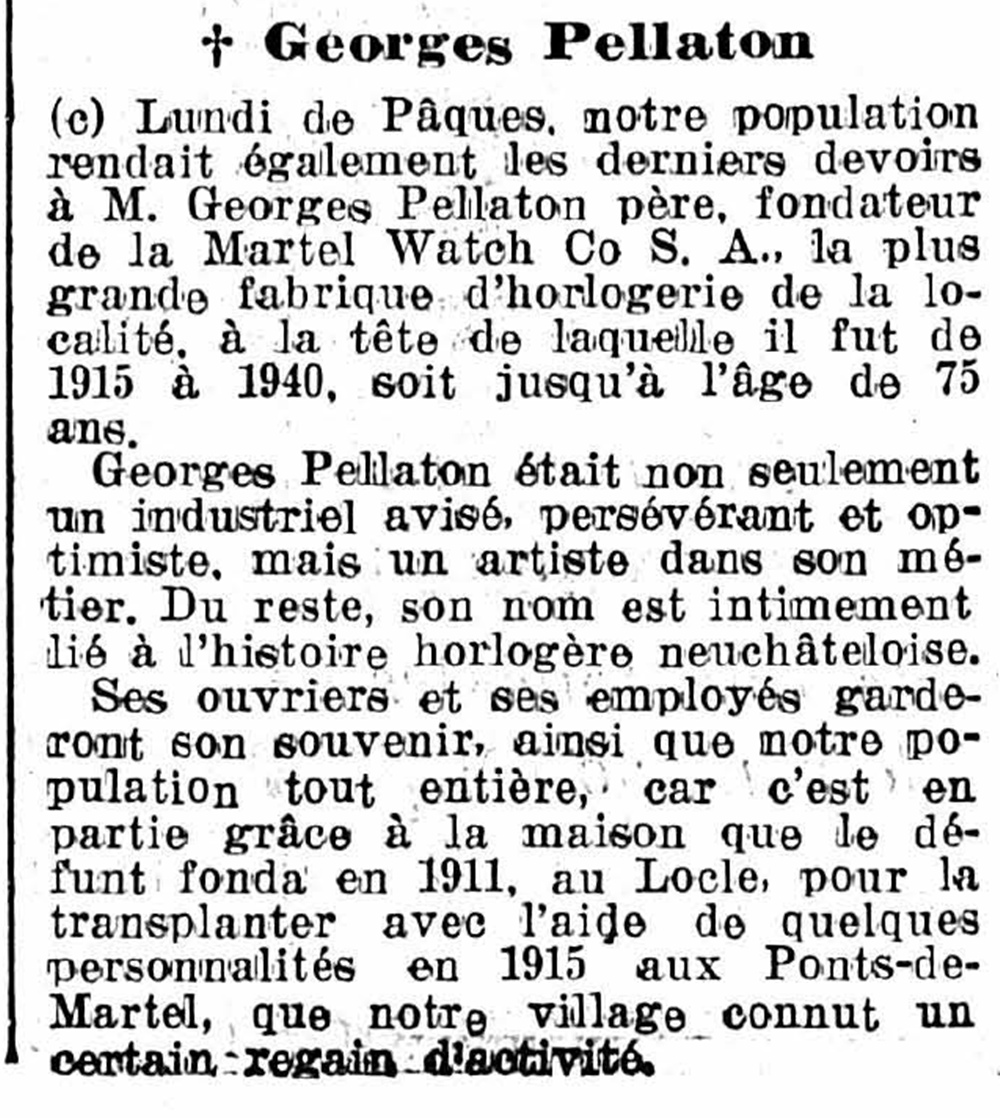
On April 10, 1950, the founder, Georges Pellaton, passed away. By that time, he had handed over the reins of the company to his three sons: Georges Jr. (instrumentation and ébauches), Raoul (finishing, assembly, and sales), and René (accounting).

"Martel Watch" watches, produced under its own brand
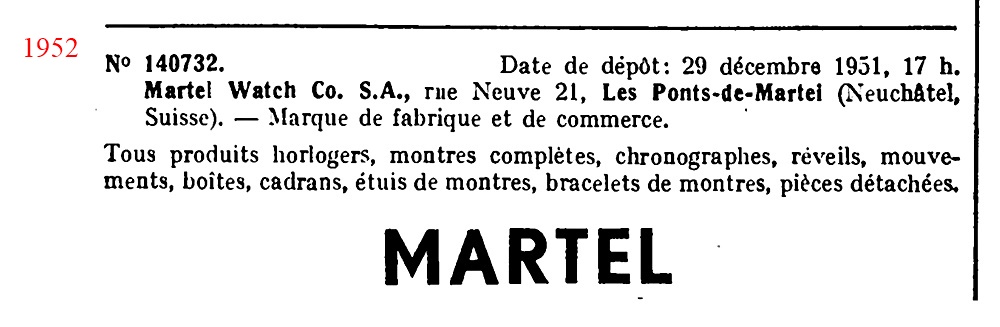
On December 29, 1951, the “Martel” trademark was registered for complete watches
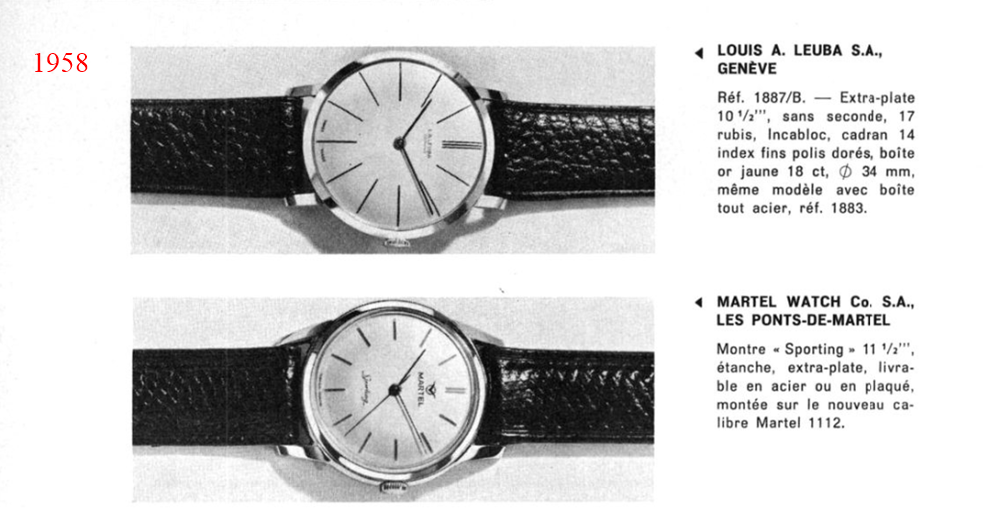
In 1952, an annex was added to the factory, equipped with new, modern equipment. In the 1950s, Martel began marketing watches under its own brand, including time-only models. A notable model from the mid-1950s was the Martel Victorious, featuring an automatic movement with a date display in a waterproof case.

Martel published a branded watch catalog in 1954, under the leadership of sales director John Matthys. The key product of this period was a line of automatic calendar watches called Victorious. These were produced in waterproof steel cases, with a gold-plated version also available. The company boasted “extreme regularity, ensured by the near-continuous operation of the rotor and precision regulation, with an easily legible date display with automatic changeover, perfect shock protection, a high-quality, individually tested, unbreakable mainspring, and a self-compensating, antimagnetic balance spring, ensuring consistent precision at any temperature.”
In 1955, a bolt from the blue. Universal ended its privileged relationship with a partner it no longer needed because, in the meantime, it had chosen to establish its own manufacturing facility. Universal Genève built its own new factory near Geneva in 1956, drastically reducing demand but opening up new opportunities for Martel. Martel had to seek new production outlets, or risk bankruptcy.
After becoming independent from Universal, Martel quickly established itself as a full-fledged watchmaker. This included registering a variety of logos.


In 1955, after the death of Georges Pellaton-Steudler, Raoul Pellaton was appointed vice-president; John-Oscar-Alphonse Matthys was appointed commercial director; on April 27, the “Flying V” trademark and a similar trademark within an “O” were registered; on July 20, the “Martel Victorious” trademark was registered; on November 2, several similar “Flying V” trademarks were registered, including in Arabic.


In 1956, on May 4, “Universal Genève” formally separated from Martel and Raoul Perret and left the board of directors; Raoul Pellaton becomes president, Georges Pellaton vice-president and René Pellaton secretary, while Robert Maire becomes technical director and joins the board of directors.


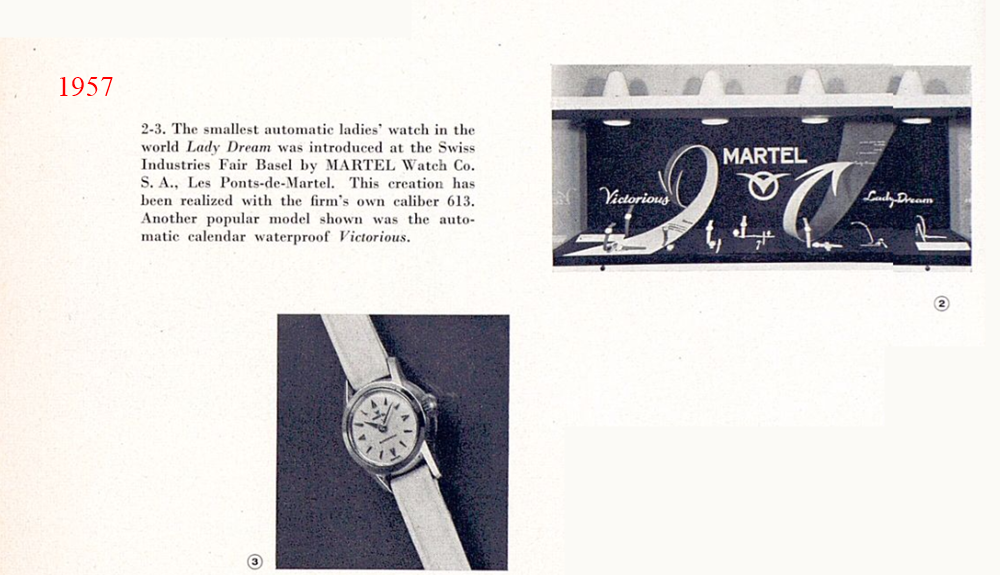
Nel 1957 il 16 marzo , il progetto di Robert Maire per un meccanismo di carica automatica riceve il brevetto svizzero 337457 per Martel; il 1° maggio viene registrato il marchio “Lady-Dream”; il 3 dicembre il progetto di Georges Pellaton per una frizione a carica automatica riceve il brevetto svizzero 343300 per Martel.
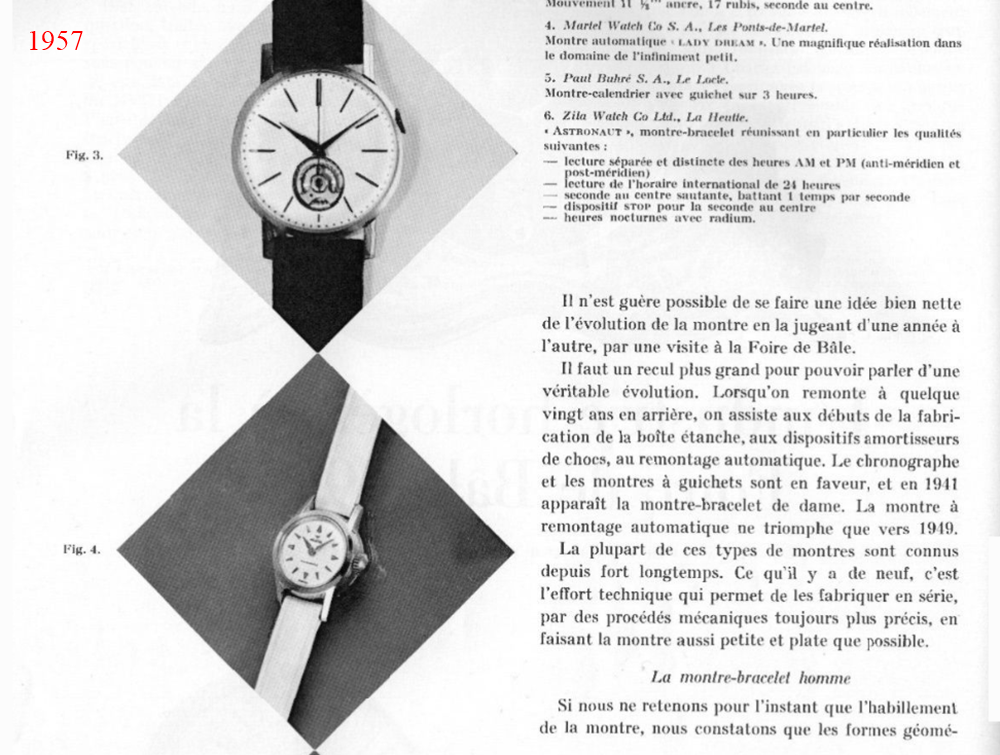
Il pezzo forte di Martel alla Fiera di Basilea del 1957 fu il Lady Dream, il più piccolo orologio automatico mai prodotto. Utilizzava il Cal. 613. La fine degli anni ’50 vide nuovi prodotti e clienti, inclusa una crescente dipendenza dal proprio marchio.


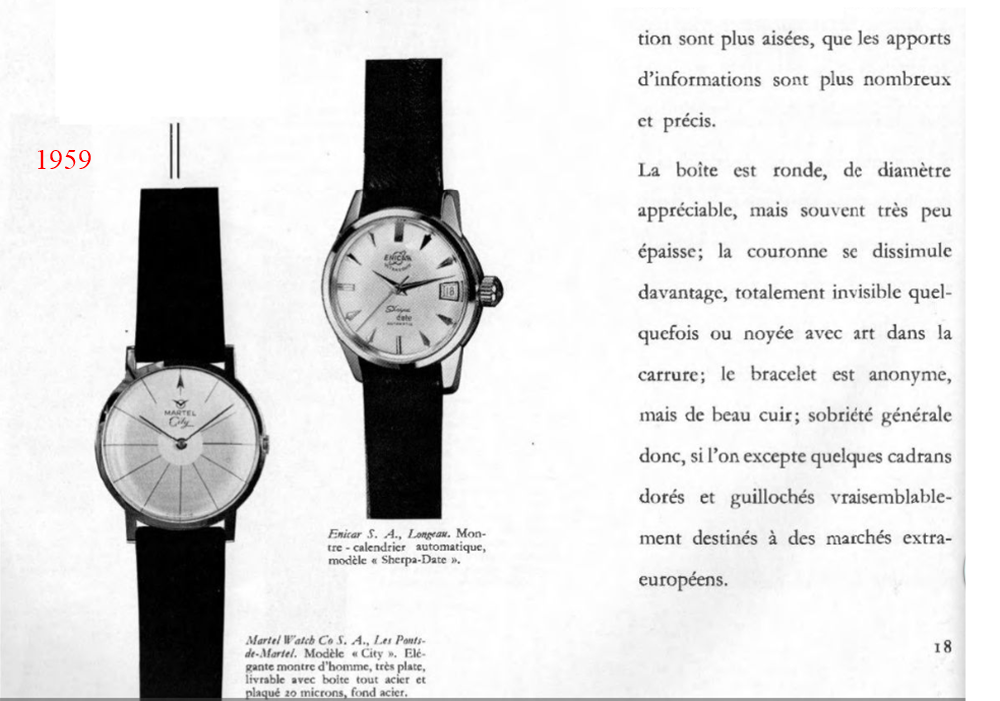

In 1959, on September 29th, Robert Maire’s design for an automatic reversal mechanism received Swiss patent 344370 for Martel.
However, the idea of pursuing the market under its own brand for a long time, costly and uncertain at a time when international competition was becoming formidable, was discarded after a few years.
The only solution was to seek another sponsor. But Zenith would soon intervene and change the company’s fate. Thus, at the end of 1959, Martel Watch was acquired by Zenith, a Le Locle-based manufacturer historically dependent on external suppliers (including Martel itself) for its chronographs, which became the majority shareholder. The company underwent a reorganization following the purchase of Zenith; Raoul Pellaton Junior became president, Georges Pellaton-Rickli vice-president, Robert Maire secretary, and Jean-Pierre de Montmollin, René Gugger, and Jean-Pierre Hainard joined the board of directors; former director René-Philippe Pellaton and former commercial director John-Oscar-Alphonse Matthys were removed.

And so, in 1961, “Martel Watch” celebrated its 50th anniversary.

“A watch factory in Ponts-de-Martel celebrates its fiftieth anniversary
Just a few days ago, one of the most important factories in our region—employing more than a quarter of our families—Martel-Watch in Ponts-de-Martel celebrated its fiftieth anniversary with an event in a most cordial atmosphere. Raoul Pellaton, Chairman of the Board of Directors of Martel-Watch, opened the official event with warm greetings to all the over one hundred attendees. Among the distinguished guests were: Mr. Fritz Matthey and Mr. Eric Perrenoud, representatives of the District Watch Manufacturers’ Association; Mr. John Perret and Mr. Hermann Feuz, President and Vice-President, respectively, of the Ponts City Council; Mr. Samuel and Mr. Alfred Emery, representatives of the Réunies des Ponts Balance Manufacturers; and Mr. Jean-Pierre de Montmollin, Chairman of the Board of Directors of Fabriques de Montres Zénith du Locle, as well as its directors, MM. Hainard, Robert, and Oesch.
Let’s not forget that Mrs. Georges Pellaton-Dubois, widow of the founder, was present at the event. Mr. Georges Pellaton-Dubois belonged to a distinguished family of watchmakers; his father, in fact, already made tourbillons at home, and it was he who introduced his children to this branch of watchmaking in Le Locle. He himself was the son of a large family: four sisters and eight brothers; all were qualified, even renowned, watchmakers; one of them, Mr. James Pellaton, was the esteemed director of the Technicum du Locle!
It was therefore in 1911 in Le Locle that Mr. Georges Pellation-Dubois opened the “mother factory,” and three years later he moved to Les Ponts under the current company name: “Martel-Watch,” where his three sons came to work successively: MM. Georges, René, and Raoul. Initially, the sketches were made on the first floor of the factory; the ground floor was occupied by garages; as for the final touches, this was carried out in the rooms above the Fabrique Mathey-Tissot. In 1937, the first expansion took place; the garages on the ground floor of the factory gave way to workshops. Finally, in 1940, all watchmaking production was grouped under one roof; two large floors were added to complete the building and give it its current layout. First, the complicated watch, known as the “repeating” watch, was built; then, through subsequent developments to meet the public’s tastes, more advanced specializations were achieved: the “chronograph watch”; finally, the “calendar watch.”
All the speeches given were of high quality and expressed with great kindness and pertinence the excellent relations that “Martel-Watch” has constantly maintained with the Ponts authorities, with the Balanciers Réunies des Ponts factory, with the the large watchmaking company Zénith du Locle, as well as the good understanding that exists between employers and employees. To this end, the following spoke: Mr. Fritz Matthey, representing the Association of Watchmakers of the district; Mr. Samuel Emery, on behalf of the Fabriques de Balanciers Réunies des Ponts; Mr. Jean-Pierrè de Montmollin, on behalf of the Board of Directors of the Zénith du Locle. The technical director, Mr. Robert Maire, congratulated the jubilarians: Mr. Georges Pellaton-Rickll, 50 years old; Ms. Bluette Vuille and Mr. Raoul Pellaton, 40 years old; Ms. Ruth Johann, MM. René Huguenin, Alfred Jeanneret, Samuel Randin, Arnold Thiébaud, Henri Thiébaud, Charles Vermot and Pierre Randin, 25 years old. Mr. and Mrs. Pierre Randin have 20 years of concierge service. Mr. Willy Humbert expressed the staff’s gratitude. The Hôtel du Cerf, the venue for the celebration, also hosted the entertainment, which took place in the most radiant atmosphere. The excellently served lunch for over a hundred guests, including the wives of the jubilee recipients, was followed by an evening of genuine joy and great entertainment, which lasted until late into the night.”
Biblio-webgrafia
1. https://orologi.forumfree.it/?t=40367342
2. https://orologi.forumfree.it/?t=63715169
3. https://orologi.forumfree.it/?t=66408710
4. https://orologi.forumfree.it/?t=67328989
5. https://orologi.forumfree.it/?t=68277068
6. https://orologi.forumfree.it/?t=73933994
7. www.watchuseek.com/threads/a-short…ographs.660565/
8. www.10e10.ch/207101/index.html [Anno 2012]
9. https://wiki.grail-watch.com/index.php/Martel_Watch
10. www.eda.admin.ch/content/dam/PRS-W…ltkriege_IT.pdf
11. www.blogdeipreziosi.it/kintaro-hattori-fondatore-seiko/
12. Universal watch Geneve. Cronografi e orologi da polso complicati. Ediz. Italiana di Sala Pietro Giuliano, Roberto Vallardi, ed. 2010
13. www.e-newspaperarchives.ch/?a=d&d=…N——–0—–

A GHOST FROM THE DEEP
The story of the Enicar Aqua-Lung 1000 ft:the watch that should never have existed